




A Complete Guide for Engineers and Procurement Teams
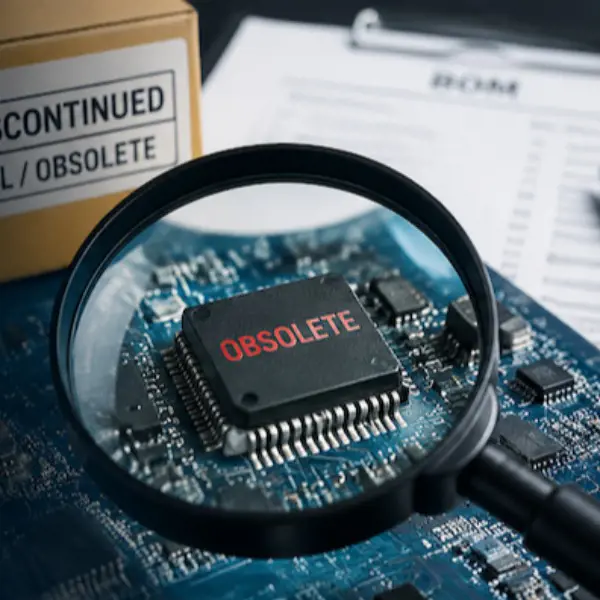
Many companies face the same dilemma: the product is still selling, the firmware is stable, and the hardware has passed certification—but a single critical IC is no longer available. A single discontinued microchip can force a factory to pause production, delay customer shipments, or risk redesigning a validated printed circuit board (PCB) that has already passed rigorous testing. For engineering and procurement teams, dealing with obsolete electronic components is a high-stakes challenge. When parts disappear from standard authorized distributor channels, projects face costly delays and the constant threat of counterfeit substitutes in the open market. This comprehensive guide explores how to navigate component obsolescence in 2026, safeguard your bill of materials (BOM), and secure reliable, hard-to-find parts without compromising quality.
1. What Are Obsolete Electronic Components?
Obsolete electronic components are parts that the original component manufacturer (OCM) has officially discontinued and no longer produces. While the physical designs, schematics, and legacy equipment utilizing these components may still be fully operational in the field, silicon fabrication lines have shifted to newer, higher-margin nodes. Consequently, procurement teams must rely on secondary markets, excess inventory, and specialized global distributors to maintain legacy support.
2. Why Components Become Obsolete Faster Today?
Sourcing obsolete parts has grown increasingly complex due to rapid structural shifts across the technology and manufacturing sectors:
-
Product Lifecycle Reduction: Commercial semiconductor lifecycles are shrinking dramatically, forcing frequent and abrupt product transitions.
-
Manufacturer Prioritization: Semiconductor manufacturers continually prioritize new product families, high-volume devices, advanced process nodes, and cost-efficient production lines over legacy parts.
-
Industry and Supply Chain Factors: Manufacturer consolidation, legacy factory shutdowns, low-volume production discontinuations, and unpredictable supply chain disruptions routinely destabilize traditional inventory reserves.
3. Understanding Active, NRND, EOL, and Obsolete Status
Navigating component lifecycle milestones requires understanding critical lifecycle phases to prevent sudden supply crunches:
| Status | Meaning | Recommended Action |
|---|---|---|
| Active | The component is in full production and readily available. | Standard monitoring |
| NRND (Not Recommended for New Designs) | The manufacturer still produces the part, but advises against using it in fresh designs because a successor is available. | Prepare replacement strategies |
| EOL (End-of-Life) | Official notification that the manufacturer is discontinuing production, usually with a Last-Time-Buy window. | Consider a Last-Time Buy (LTB) |
| Obsolete | Production has entirely ceased. Inventory is limited to existing stock, broker networks, and secondary market channels. | Find verified independent sources |

4. Where Can You Source Obsolete Components?
When authorized distributors run dry, procurement teams look to alternative sourcing channels. Comparing these options helps balance risk and availability:
4.1 Authorized Distributors
-
Advantages: Strong traceability, direct manufacturer relationships, and standard quality procedures.
-
Limitations: Usually focus on active products, with limited or zero obsolete inventory.
4.2 Independent Component Distributors
-
Advantages: Access to global excess inventory, surplus stock, and difficult-to-find legacy parts.
-
Risks: Requires rigorous supplier and quality verification before purchase.
4.3 Excess Inventory Brokers and Marketplaces
-
Advantages: High availability of spot-market inventory.
-
Risks: Variable traceability and higher exposure to counterfeit components if strict vetting is omitted.
5. How To Verify Obsolete Components Before Purchase?
The greatest risk in the obsolete market is not finding the part—it is ensuring that the part is authentic and undamaged. Verifying obsolete parts requires strict quality control protocols:
-
Documentation Check: Requesting original manufacturer packaging, Certificates of Conformance (CoC), and full lot/date code traceability records.
-
Visual Inspection: Checking package markings, pin conditions, dimensions, and texture against factory standards using high-magnification microscopy.
-
X-Ray Inspection: Examining internal die structures, bond wires, and lead frames to ensure internal integrity matches authentic manufacturer specifications.
-
Electrical Testing: Utilizing advanced testing labs to validate functional parameters, voltage thresholds, and switching speeds.
6. Supplier Verification Checklist
Before issuing a purchase order to an obsolete component supplier, procurement teams should verify the vendor against these essential criteria:
- Real Stock Evidence: Does the supplier provide actual stock photos and date code information?
- Factory Packaging: Is the inventory stored in original factory-sealed packaging or anti-static shielding?
- Traceability Documentation: Can they provide a clear chain of custody back to the original manufacturer or authorized source?
- In-House Testing Capabilities: Do they operate dedicated testing labs for X-ray, visual, and electrical inspection?
- Warranty and Return Policy: What quality guarantee or replacement terms back the transaction?

7. Common Procurement Mistakes When Buying Obsolete Parts
Sourcing outside primary channels introduces major risks if proper safeguards are ignored:
-
Buying Without Traceability: Purchasing from brokers who cannot provide a clear chain of custody back to the original factory.
-
Choosing the Lowest Price: Prioritizing unit cost over supplier reliability, which frequently leads to counterfeit, remarked, or substandard components.
-
Ignoring Date Codes: Overlooking mismatched or excessively old date codes that may indicate improper storage, moisture damage, or degraded solderability.
8. What To Do When Components Are Completely Unavailable?
If sourcing stock proves entirely unviable, teams must pivot to alternative strategies:
-
Functional Replacement: Finding a drop-in or pin-compatible functional equivalent from another manufacturer, such as transitioning a legacy microcontroller to a newer ARM Cortex-M based architecture.
-
Redesign: Modifying the circuit board layout to accommodate active, current-generation components.
-
Lifetime Buy (LTB): Purchasing and securely storing enough inventory during the manufacturer's LTB window to cover the entire remaining lifecycle of the product.
Real-World Example: Recovering a Discontinued Industrial IC
An industrial equipment manufacturer recently faced a critical bottleneck when a core controller IC for an existing production line was abruptly discontinued. Redesigning the PCB would require new safety certifications and six months of engineering delays. By partnering with specialized global sourcing networks and conducting rigorous X-ray and electrical verification, replacement stock was successfully identified, tested, and delivered—keeping the manufacturing schedule intact without a costly redesign.
9. How LoveChip Helps Source Obsolete Components
LoveChip bridges the gap between obsolete scarcity and production continuity through a transparent, rigorous sourcing ecosystem:
-
Part Number & BOM Submission: Submit your target part numbers, target quantities, and required delivery timelines via our BOM Kitting Services portal.
-
Global Inventory Matching: Our team scans international databases and trusted networks to locate scarce IC Chips and legacy semiconductors.
-
Strict Quality Verification: Every batch undergoes physical, microscopic, and electrical checks in our advanced testing facilities to ensure authenticity.
-
Secure Delivery: Verified components are shipped with clear documentation and full supply chain transparency.
Ready to secure your hard-to-find components? Contact our sourcing team today to check global availability for your BOM.
FAQ
Q1: Where can I buy obsolete IC chips?
You can source obsolete integrated circuits through specialized independent global distributors and trusted supply chain partners like LoveChip that maintain vetted global networks and rigorous testing protocols.
Q2: Are obsolete electronic components still reliable?
Yes, provided they have been stored under proper environmental controls (temperature and humidity regulation) and verified through strict testing protocols such as X-ray inspection and electrical bench testing to ensure they are authentic and undamaged.
Q3: What is the difference between EOL and obsolete components?
An EOL (End-of-Life) component is marked for discontinuation, with a final window (Last-Time Buy) to order remaining factory stock. An Obsolete component is one where manufacturing has completely ceased, and supply is limited to existing market inventory.
Q4: How do I verify discontinued semiconductor parts?
Verification involves a multi-step quality assurance process including microscopic visual checks for package anomalies, X-ray analysis of internal bond wires, electrical parameter testing, and checking lot/date code traceability against manufacturer data sheets.
Q5: Can obsolete components be used in new production?
While possible, it is generally discouraged for new designs because long-term supply stability cannot be guaranteed. They are best reserved for legacy maintenance, repair operations (MRO), or short-run production batches where a redesign is cost-prohibitive.


